




- dogs
- good friends
- hot water
- laundry starch
- espresso
- fountain pens
- democracy
- pre-made gravy
- Turner Classic Movies
- my family
- antibiotics
- the printing press
- gratitude
Thursday, November 22, 2007
Today...
I give thanks for:

Tuesday, November 20, 2007
Fantastic Potties...
Ayah, so, it's no secret that I seem to have a weird thing about fabulous bathrooms. Maybe it's because for the last few years I have not had a fabulous bathroom.
Maybe it's because when I was a kid we lived overseas, in countries where, compared to the standard 1960s tiny tub and pink sink, the bathrooms were fabulous indeed--huge deep tubs, bidets (which make perfect Barbie swimming pools don't you know) and towering pedestal sinks.
I vividly remember our first trip to Paris, where we stayed in a tiny hotel that had all the early 20th century mod cons, including a tub the size of a cattle trough, which sat dainty on claw-feet. No shower, of course. I got out of the tub the first day, misjudged the drop to the floor (American tubs always sit square on mother earth), and almost beaned myself on the cast-iron edge.
Then, in my callow youth, I lived in an apartment that had, in addition to a water closet, a bathroom that was the size of a small bedroom. It was big enough to contain a sofa, a chest of drawers, an enormous bathroom, and a small sink. We painted the room blood red, and lit it with candles. The flat had no heat, so during the winter, I would fill the enormous tub with boiling hot water, and lie on the sofa reading by candlelight. That tub was big enough to fit three girls, sitting like peas in a pod, or one girl floating completely stretched out, and, when full of hot water, it generated enough steam to turn the room into a sauna. Ah, that tub...
Anyway, now I have a very un-fantastic bathroom and no tub at all. But I try to make up for this lack in my stories which often contain wish-fulfillment lavs. Or characters, who like me, lack fabulous bathrooms (or fluffy towels) and crave both.
Bringing me to the true point of this post, which is to that the FT has an article about some truly fantastic potties. The article was written by Lucinda Lambton, who also has published a history of fabulous loos called Temples of Convenience, which looks totally awesome. There was a golden age of bathrooms--and we are not now in it.
To paraphrase Tolkien: "Indoor plumbing is a noble thing!"
Maybe it's because when I was a kid we lived overseas, in countries where, compared to the standard 1960s tiny tub and pink sink, the bathrooms were fabulous indeed--huge deep tubs, bidets (which make perfect Barbie swimming pools don't you know) and towering pedestal sinks.
I vividly remember our first trip to Paris, where we stayed in a tiny hotel that had all the early 20th century mod cons, including a tub the size of a cattle trough, which sat dainty on claw-feet. No shower, of course. I got out of the tub the first day, misjudged the drop to the floor (American tubs always sit square on mother earth), and almost beaned myself on the cast-iron edge.
Then, in my callow youth, I lived in an apartment that had, in addition to a water closet, a bathroom that was the size of a small bedroom. It was big enough to contain a sofa, a chest of drawers, an enormous bathroom, and a small sink. We painted the room blood red, and lit it with candles. The flat had no heat, so during the winter, I would fill the enormous tub with boiling hot water, and lie on the sofa reading by candlelight. That tub was big enough to fit three girls, sitting like peas in a pod, or one girl floating completely stretched out, and, when full of hot water, it generated enough steam to turn the room into a sauna. Ah, that tub...
Anyway, now I have a very un-fantastic bathroom and no tub at all. But I try to make up for this lack in my stories which often contain wish-fulfillment lavs. Or characters, who like me, lack fabulous bathrooms (or fluffy towels) and crave both.
Bringing me to the true point of this post, which is to that the FT has an article about some truly fantastic potties. The article was written by Lucinda Lambton, who also has published a history of fabulous loos called Temples of Convenience, which looks totally awesome. There was a golden age of bathrooms--and we are not now in it.
To paraphrase Tolkien: "Indoor plumbing is a noble thing!"
Viking Rock!
Over at his lj page,  psamphire has the some awesome clips of a Viking heavy metal band called Turisas. Check them out--when was the last time you saw a blood-stained marauder covering Boney M's Rasputin? Or a heavy metal band manly enough to include accordions in their line-up?
I tell ya, Hardhands himself would be jealous.
psamphire has the some awesome clips of a Viking heavy metal band called Turisas. Check them out--when was the last time you saw a blood-stained marauder covering Boney M's Rasputin? Or a heavy metal band manly enough to include accordions in their line-up?I tell ya, Hardhands himself would be jealous.
Monday, November 19, 2007
Reading Counts...
The New York Times reports that an NEA study show a link between low test stores and reading for pleasure. That is: kids who don't read for fun have lower test scores in reading and writing--and math and science--than those who do read. Kids who grow up in homes that have less than ten books score lower than kids who grow up in homes with more than a hundred books--and this holds true even when the stats are adjusted for income and college degrees.
Somehow this doesn't come as a surprise to me.
Of course, as in all studies, some experts disagree, but still, it seems rather elementary to me that reading does matter--in test scores and in life.
I am glad to report that Bothwell is growing up in a house with many many books. If only he could read.
Somehow this doesn't come as a surprise to me.
Of course, as in all studies, some experts disagree, but still, it seems rather elementary to me that reading does matter--in test scores and in life.
I am glad to report that Bothwell is growing up in a house with many many books. If only he could read.
Friday, November 16, 2007
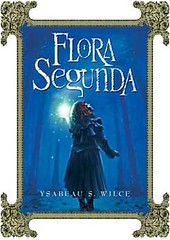
Flora Segunda on Audio
Finally, the audio of Flora Segunda has shown up on Amazon.
Perfect for long car trips, or to while away the time while being stuffed into an economy class airline seat, no?
Perfect for long car trips, or to while away the time while being stuffed into an economy class airline seat, no?
Title Change!
Well, Flora Redux is no more...
I would like to introduce instead (drumroll please):
Flora's Dare,
I would like to introduce instead (drumroll please):
How a Girl of Spirit Gambles All to
Expand her Vocabulary,
Confront a Bouncing Boy Terror
And Try to Save Califa from a Shaky Doom
(Despite Being Confined to Her Room.)
WFC Books.
So, of course at WFC, we got giant goodie bags full of books, and actually I guess I should be saying "duffle bags" of books, because that's actually what the goodie bags were--giant duffle bags. This was a nice change from all the book bags that I have gotten over the years and which I have never had much use for. I would have much use indeed for the duffle bag, except that I couldn't bring it back me and stick to my "carry-on only" policy. So I filled it full of the books that I did not want, and then dropped it off at the Saratoga Library on the way out of town, feeling oh-so-virtuous for recycling.
But the books inside the bag. Some I had no interest in, and promptly put in the give away pile. Others that were intriguing until I got a few pages in. For eg. there was a book (no names please) about a family that could shape-shift into dragons, set in the 18th century. It started out strong, but then it quickly turned into a what I call a "woman-breaking" book. Which is to say, a book about a man takes a strong independent woman and breaks her down into a subservient domestic wife. If you saw this story on American Justice you'd be out-raged at the misogyny of it all--but somehow with dragons and romance, it's okay.
No, it's not.
Jay Lake's Trial of Flowers, with its gorgeous Nightshade Books cover. I've only read a few pages in, but I'll definitely keep going. The City Imperishable is weird and grotesquely wonderful, and full of quirky darkness. Plus, I'm a sucker for Salammbo-esque world, and The Trial of Flowers is decadent all the way. It's crying out to be illustrated by Mahlon Blaine.
Also kept, and now on my stack to read:
The Electric Church by Jeff Somers, which appears to be a dystopian futuristic cyber-hardboiler. Which is the way I like my hard-boilers, for the most part. (See Richard K. Morgan.)
Acacia by David Anthony Durham, whom I had a lovely chat with at the Orbit party. A fantasy set in a sort of pre-Classical world. Looks like some of the standard fantasy tropes--kings, rebellions, revenge--but from the first twenty pages or so, definitely better done than most of this genre. I hope that doesn't sound like damning with faint praise.
Black Ships by Jo Graham. I read this one is one sitting--while deadly ill with a deadly cold--which tells you something about how engrossing it was! A retelling of The Aeneid, with characters that the reader can empathize with, and yet which retain a sense of historical "otherness". This book is set a long long time ago. People were the same then as they are today, but they were also very different. Narrated by Sibyl, a priestess of the dead, the story follows the last survivors of Wilusa (Troy), as they travel through the Mediterranean looking for a new home. Graham mixes legend with history to good effect, and though she adds a dollop of fantasy here and there, for the most part the book is set in the realm of the historical Classical World. Conveying an authentic historical voice without straying into modernism is a hard trick to pull off, but Graham succeeds beautifully. Her characters are compelling, achingly real, and, despite, the horrors they witness, hopeful. She deals with the harsh reality of warfare in the Ancient World directly and without flinching, and yet her story never strays into melodrama or sentimentalism. Graham's handling of some of the more difficult aspects of Classical life--including sex and rape--is deft. The people of the Classical world had dramatically different attitudes towards these things than we do today, and Graham presents these attitudes in a straight-forward way that is neither judgmental nor sleazy. A great book and one that I highly recommend.
Later, books I read last week that did not come out of the Duffle Bag!
But the books inside the bag. Some I had no interest in, and promptly put in the give away pile. Others that were intriguing until I got a few pages in. For eg. there was a book (no names please) about a family that could shape-shift into dragons, set in the 18th century. It started out strong, but then it quickly turned into a what I call a "woman-breaking" book. Which is to say, a book about a man takes a strong independent woman and breaks her down into a subservient domestic wife. If you saw this story on American Justice you'd be out-raged at the misogyny of it all--but somehow with dragons and romance, it's okay.
No, it's not.
Jay Lake's Trial of Flowers, with its gorgeous Nightshade Books cover. I've only read a few pages in, but I'll definitely keep going. The City Imperishable is weird and grotesquely wonderful, and full of quirky darkness. Plus, I'm a sucker for Salammbo-esque world, and The Trial of Flowers is decadent all the way. It's crying out to be illustrated by Mahlon Blaine.
Also kept, and now on my stack to read:
The Electric Church by Jeff Somers, which appears to be a dystopian futuristic cyber-hardboiler. Which is the way I like my hard-boilers, for the most part. (See Richard K. Morgan.)
Acacia by David Anthony Durham, whom I had a lovely chat with at the Orbit party. A fantasy set in a sort of pre-Classical world. Looks like some of the standard fantasy tropes--kings, rebellions, revenge--but from the first twenty pages or so, definitely better done than most of this genre. I hope that doesn't sound like damning with faint praise.
Black Ships by Jo Graham. I read this one is one sitting--while deadly ill with a deadly cold--which tells you something about how engrossing it was! A retelling of The Aeneid, with characters that the reader can empathize with, and yet which retain a sense of historical "otherness". This book is set a long long time ago. People were the same then as they are today, but they were also very different. Narrated by Sibyl, a priestess of the dead, the story follows the last survivors of Wilusa (Troy), as they travel through the Mediterranean looking for a new home. Graham mixes legend with history to good effect, and though she adds a dollop of fantasy here and there, for the most part the book is set in the realm of the historical Classical World. Conveying an authentic historical voice without straying into modernism is a hard trick to pull off, but Graham succeeds beautifully. Her characters are compelling, achingly real, and, despite, the horrors they witness, hopeful. She deals with the harsh reality of warfare in the Ancient World directly and without flinching, and yet her story never strays into melodrama or sentimentalism. Graham's handling of some of the more difficult aspects of Classical life--including sex and rape--is deft. The people of the Classical world had dramatically different attitudes towards these things than we do today, and Graham presents these attitudes in a straight-forward way that is neither judgmental nor sleazy. A great book and one that I highly recommend.
Later, books I read last week that did not come out of the Duffle Bag!
Gone & Probably Forgotten.
Line edits take a long time. Particularly when you are sick and traveling.
I'm just saying.
I'm just saying.
Saratoga AAR
WFC was fabulous, as always, though insanely busy, trying to track everyone down that I wanted to track down, and keep up with parties, and panels, and hob-nobbing, and all those other lovely con activities. The hotel was not so great--they seemed ill prepared for a thousand rabid writers and fans descending on them--in fact, it got so overwhelming at the bar, that they actually had to open up another bar in the lobby to handle the overflow. Though the hotel billed itself as a conference center, I'm guessing that conventions of dentists or accountants don't drink as much as writers do. Just a guess, there.
I was on one panel that was interesting, tho' through no fault of mine own: Tolkien as Horror Writer. The other experts had far more to say about Tolkien as Horror Writer than I did, but I hope I lent the appropriate moral support to their arguments just by nodding sagely as they talked. I was put on the panel at the last minute, as a courtesy, which worked out better for me than it did for the audience, I fear. Anyway, if I didn't hold the panel up, at least I didn't send it plummeting to the ground either, so all in all, a success.
I saw many people, all delightful, and none of whom I shall namecheck here, both to protect their innocence, and because I'm too darn lazy to look up all the lj/blogger ids. For me the whole point of WFC is to see people whom I otherwise would never see, and this year was no exception. I'm only sorry that I didn't see half as many people for twice as long as I would have liked.
Many parties, all of which blurred into one another, with the exception the party hosted outside the hotel by Orbit Publishing. It was a polished bash, with an open bar, and yummy canapes, and tho' I never did figure out who was there in the flesh representing the publisher, so as to thank them, I had a lovely time. I hate going to parties and not being able to thank the hosts directly--it feels so rude to eat and drink at someone else's expense and not at least say thanks, but these events are often so crazy that it's impossible to determine who to thank. So, a bit late, but hopefully better than never, Orbit Publishing--thanks for the great time!
I did not win the World Fantasy Award for Best Novella; that honour went to Jeff Ford, who richly deserved it, of course. I didn't expect to win, and was slightly relieved not to do so. In my humble opinion, my story was good, but it wasn't better than the others on the slate, and I will be the first to admit it. It was an honour just to be nominated. No, really, it's true. Hundreds of stories are published each year; to get singled out as being one of the best is fabulous, and more than I could have ever hoped for. I despaired of finishing that story--I never thought I'd do it--the first story I completed after Clarion, and it took me two years. So to have it recognized at all felt pretty darn good. And I can't ask for anything more.
Oh, and I should mention too that Sharyn November read the Best Acceptance Speech Ever as written by Diana Wynne Jones who was awarded the Lifetime Achievement Award, but couldn't make it to the con. The combination of Madama Jones's words and Madama November's voice was amusing, and the speech itself was great. I hope it will be published somewhere because it's worth reading if you missed hearing it.
I only went to a two readings, both of them (weird coincidence) by men named Paul, both of whom I rank among my favorite writers, ever.
First: Paul Park, who read an astounding story about events that never happened, characters that never lived Aren't all stories about imaginary events and characters? Oh, I didn't say they were imaginary--only that they never happened, never lived. It's not the same thing, at all. Every time I read or listen to something that Sieur Park has written, I am astounded. Where does he get his ideas? How does he think of this stuff? His work is always revelatory, and I always find myself thinking about his stories for a long time afterward. If you haven't read Celestis or Soldiers of Paradise, you should.
Second: Paul Witcover, who read from his current in-process novel, which is about clockwork, and the Devil, and evil cats. Paul's last book, Tumbling After, was set a psychological drama with fantastic elements, a sort of Gaslight with Gaming. The current work is more traditional fantasy, but definitely is going to get the full Witcover treatment. I'm looking forward to reading the whole thing, so he'd better keep working on it (hint hint.)
What is with these Pauls that they all seem to have such astounding twisty-turny minds? I grow suspicious and wary...
I ended WFC on a low note with an attack of the Saratoga Tum, which had earlier felled others both greater and wiser than me. Still, what is joy without sorrow--the bitter makes the sweet all the sweeter.
Next year, Calgary, brr.
I was on one panel that was interesting, tho' through no fault of mine own: Tolkien as Horror Writer. The other experts had far more to say about Tolkien as Horror Writer than I did, but I hope I lent the appropriate moral support to their arguments just by nodding sagely as they talked. I was put on the panel at the last minute, as a courtesy, which worked out better for me than it did for the audience, I fear. Anyway, if I didn't hold the panel up, at least I didn't send it plummeting to the ground either, so all in all, a success.
I saw many people, all delightful, and none of whom I shall namecheck here, both to protect their innocence, and because I'm too darn lazy to look up all the lj/blogger ids. For me the whole point of WFC is to see people whom I otherwise would never see, and this year was no exception. I'm only sorry that I didn't see half as many people for twice as long as I would have liked.
Many parties, all of which blurred into one another, with the exception the party hosted outside the hotel by Orbit Publishing. It was a polished bash, with an open bar, and yummy canapes, and tho' I never did figure out who was there in the flesh representing the publisher, so as to thank them, I had a lovely time. I hate going to parties and not being able to thank the hosts directly--it feels so rude to eat and drink at someone else's expense and not at least say thanks, but these events are often so crazy that it's impossible to determine who to thank. So, a bit late, but hopefully better than never, Orbit Publishing--thanks for the great time!
I did not win the World Fantasy Award for Best Novella; that honour went to Jeff Ford, who richly deserved it, of course. I didn't expect to win, and was slightly relieved not to do so. In my humble opinion, my story was good, but it wasn't better than the others on the slate, and I will be the first to admit it. It was an honour just to be nominated. No, really, it's true. Hundreds of stories are published each year; to get singled out as being one of the best is fabulous, and more than I could have ever hoped for. I despaired of finishing that story--I never thought I'd do it--the first story I completed after Clarion, and it took me two years. So to have it recognized at all felt pretty darn good. And I can't ask for anything more.
Oh, and I should mention too that Sharyn November read the Best Acceptance Speech Ever as written by Diana Wynne Jones who was awarded the Lifetime Achievement Award, but couldn't make it to the con. The combination of Madama Jones's words and Madama November's voice was amusing, and the speech itself was great. I hope it will be published somewhere because it's worth reading if you missed hearing it.
I only went to a two readings, both of them (weird coincidence) by men named Paul, both of whom I rank among my favorite writers, ever.
First: Paul Park, who read an astounding story about events that never happened, characters that never lived Aren't all stories about imaginary events and characters? Oh, I didn't say they were imaginary--only that they never happened, never lived. It's not the same thing, at all. Every time I read or listen to something that Sieur Park has written, I am astounded. Where does he get his ideas? How does he think of this stuff? His work is always revelatory, and I always find myself thinking about his stories for a long time afterward. If you haven't read Celestis or Soldiers of Paradise, you should.
Second: Paul Witcover, who read from his current in-process novel, which is about clockwork, and the Devil, and evil cats. Paul's last book, Tumbling After, was set a psychological drama with fantastic elements, a sort of Gaslight with Gaming. The current work is more traditional fantasy, but definitely is going to get the full Witcover treatment. I'm looking forward to reading the whole thing, so he'd better keep working on it (hint hint.)
What is with these Pauls that they all seem to have such astounding twisty-turny minds? I grow suspicious and wary...
I ended WFC on a low note with an attack of the Saratoga Tum, which had earlier felled others both greater and wiser than me. Still, what is joy without sorrow--the bitter makes the sweet all the sweeter.
Next year, Calgary, brr.
Subscribe to:
Posts (Atom)


